- Thèmes : Art, Iconologie
- Nombre de pages : 174
- ISBN : 978-2-914338-39-4
- Prix : 8,99 €
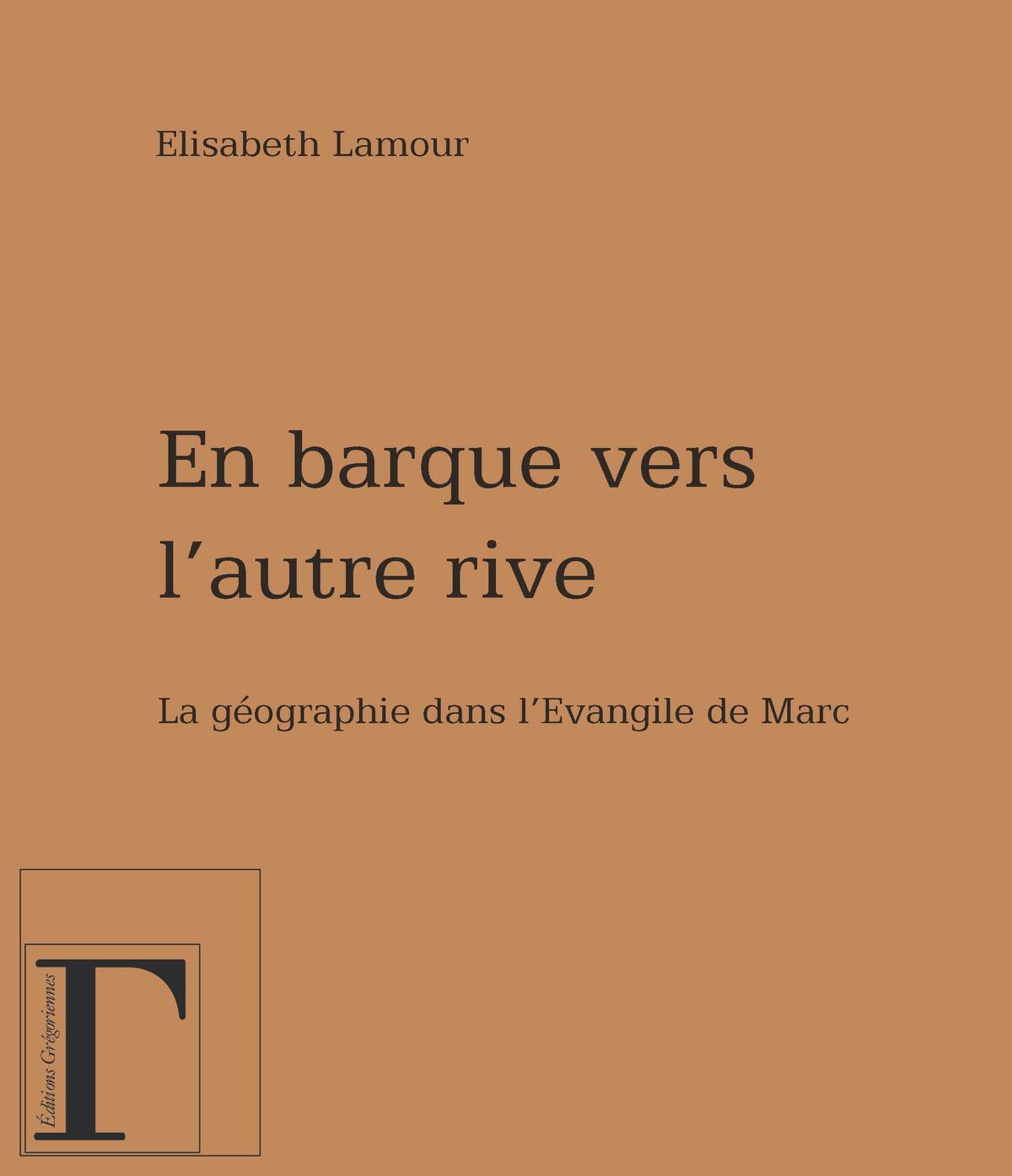
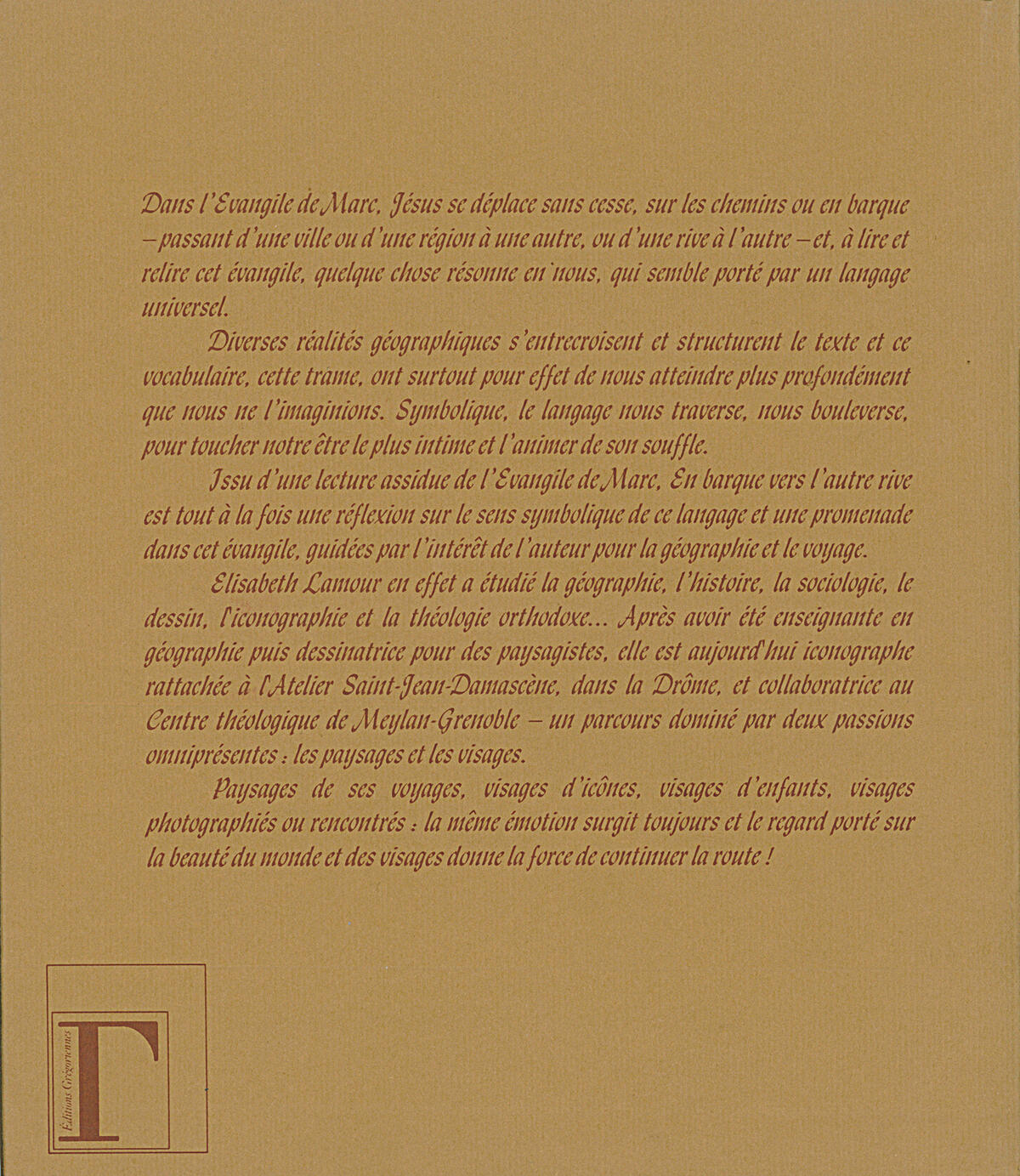
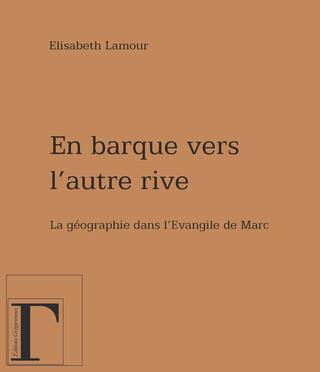
Dans l’Evangile de Marc, Jésus se déplace sans cesse, sur les chemins ou en barque – passant d’une ville ou d’une région à une autre, ou d’une rive à l’autre – et, à lire et relire cet évangile, quelque chose résonne en nous, qui semble porté par un langage universel. Diverses réalités géographiques s’entrecroisent et structurent le texte et ce vocabulaire, cette trame, ont surtout pour effet de nous atteindre plus profondément que nous ne l’imaginions. Symbolique, le langage nous traverse, nous bouleverse, pour toucher notre être le plus intime et l’animer de son souffle. Issu d’une lecture assidue de l’Evangile de Marc, En barque vers l’autre rive est tout à la fois une réflexion sur le sens symbolique de ce langage et une promenade dans cet évangile, guidées par l’intérêt de l’auteur pour la géographie et le voyage. Elisabeth Lamour en effet a étudié la géographie, l’histoire, la sociologie, le dessin, l'iconographie et la théologie orthodoxe... Après avoir été enseignante en géographie puis dessinatrice pour des paysagistes, elle est aujourd'hui iconographe rattachée à l'Atelier Saint-Jean-Damascène, dans la Drôme, et collaboratrice au Centre théologique de Meylan-Grenoble – un parcours dominé par deux passions omniprésentes : les paysages et les visages. Paysages de ses voyages, visages d’icônes, visages d’enfants, visages photographiés ou rencontrés : la même émotion surgit toujours et le regard porté sur la beauté du monde et des visages donne la force de continuer la route !
In the Gospel according to Mark, Jesus is constantly travelling, by foot or by bark, leaving one city or region for another, or crossing one bank to get to the other
In reading or rereading this Gospel, something within us resonates that somehow seems universal.
Various geographical realities intersect, giving structure to the text and words, weaving a fabric that touches us more profoundly than we could possibly imagine. The language and its symbols flow through us, moving us, reaching our inner most being and bringing it life substance.
Crossing to the other Bank is the result of an assiduous reading and is, at the same time, a reflection on the symbolic meaning of the words as well as a stroll through this Gospel, guided by the author's enthusiasm for both geography and travel.
Elizabeth Lamour studied geography, history, sociology, drawing, iconography and orthodox theology. After having taught geography and done some landscape drafting, she is presently working for the Saint-Jean Damascène Studio in the Drôme, as an iconographer, and in Meylan-Grenoble at the Theology Center : drawing on two of her passions: landscapes and faces.
Landscapes of her travels, and swarms of faces: on icons, of children, in photos, or of real life models: the same emotion always emerges; the beholder is taken by the beauty of the world and of the faces that incite him forward in his travels.
En el Evangelio de Marcos, Jesús se desplaza constantemente por los caminos o en barca. Pasa de una ciudad a otra, cambia de región, cruza a la otra orilla. Cada lectura de ese Evangelio nos evoca algo, como si fuera el mensaje de una lengua universal.
En guise de préface...
Une histoire d’objectifs...
1. L’Évangile de Marc
Comment ce texte s’est-il constitué ?
2. La géographie dans l’Évangile de Marc
3. La Galilée
La réalité géographique
Les invraisemblances géographiques . . . .
La logique de l’itinéraire de Jésus en Galilée
La Galilée : lieu de la résurrection ou lieu de la parousie ?
La Galilée des nations
Conclusion
4. L’invitation au voyage
« Terre-Patrie »
« Peuple nomade »
L’infatigable voyageur
La maison
Conclusion : « Je suis le chemin et la vérité et la vie. » (Jn 14, 6)
5. Jérusalem
La « montée » à Jérusalem
La ville
Jérusalem chez Marc
Hors de la ville...
Conclusion : « A vin nouveau, outres neuves. » (2, 22)
6. La mer
De quelle mer s’agit-il ?
Quel est le sens symbolique de la mer ?
Jésus, nouveau maître de la mer
La barque
Conclusion
7. Le désert
De quel désert s’agit-il ?
Quel est le sens symbolique du désert ?
L’évolution du sens du désert
L’absence (quelque chose de l’apophatisme)
L’eau, source de vie
Le paradis retrouvé
Conclusion
8. La montagne
De quelle montagne s’agit-il ?
Quel est le sens symbolique de la montagne ?
L’analogie avec le désert
Le thème de la montée
Conclusion
9. Le temps et l’espace
Le temps dans l’Évangile de Marc
« Tu es le présent qui s’accumule »
Hésychia
« Chemin faisant »
Conclusion : « Soyez des hommes sensés qui mettent à profit le temps présent. » (Ep 5, 15-16)
Conclusion
En barque vers l’autre rive
Répondre à l’appel
Tout lâcher
Choisir l’itinéraire
Et savoir s’arrêter (encore quelque chose de l’apophatisme)
Annexe
Petit lexique d’une géographie symbolique
Table des illustrations
Bibliographie

Nos ebooks sont des versions PDF homothétiques des livres de nos catalogues. Ils ne sont donc pas modifiables (changement de corps pour la police, modification des images). La pagination est donc respectée et la première page du livre est remplacée par la couverture.
Ce format peut être lu par le logiciel Acrobat © sur des ordinateurs ou tablettes tactiles de type iPad, Archos, Asus ou autres.