- Thèmes : Mathématique/logique, Mathématiques et physique, Physique, Sciences
- Nombre de pages : 96
- Format : 17 x 19 cm
- ISBN : 978-2-915418-14-9
- Prix : 19,00 €
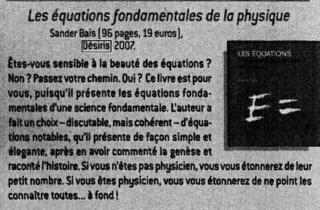
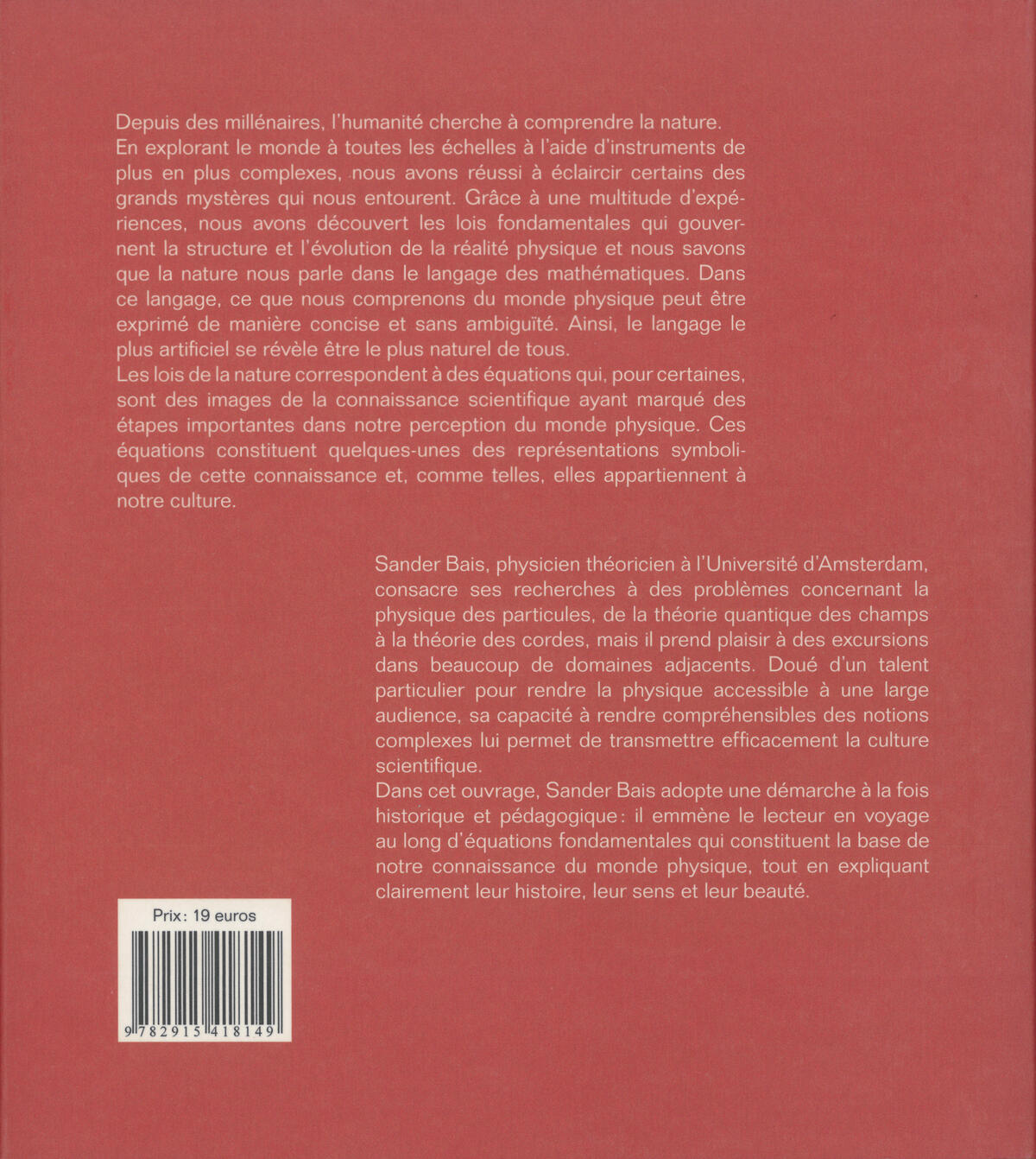
Depuis des millénaires, l'humanité cherche à comprendre la nature.
En explorant le monde à toutes les échelles à l'aide d'instruments de plus en plus complexes, nous avons réussi à éclaircir certains des grands mystères qui nous entourent. Grâce à une multitude d’expériences, nous avons découvert les lois fondamentales qui gouvernent la structure et l'évolution de la réalité physique et nous savons que la nature nous parle dans le langage des mathématiques. Dans ce langage, ce que nous comprenons du monde physique peut être exprimé de manière concise et sans ambiguïté. Ainsi, le langage le plus artificiel se révèle être le plus naturel de tous.
Les lois de la nature correspondent à des équations qui, pour certaines, sont des images de la connaissance scientifique ayant marqué des étapes importantes dans notre perception du monde physique. Ces équations constituent quelques-unes des représentations symboliques de cette connaissance et, comme telles, elles appartiennent à notre culture.
Les droits de traduction de cet ouvrage ne sont pas disponibles
For thousands of years, humanity has sought to understand nature. By exploring the world on all levels with the help of more and more complex instruments, we have succeeded in shining light on some of the great mysteries that surround us. Thanks to myriad experiments, we have discovered the fundamental laws that govern the structure and evolution of physical reality and we know that nature speaks to us in the language of mathematics. In this language, what we understand of the world of physics can be expressed in a precise manner without ambiguity. Thus, the most artificial language turns out to be the most natural of all.
The laws of nature correspond to equations which, for some, are images of scientific knowledge that have marked important stages in our perception of the physical world. These equations make up some of the symbolic representations of this knowledge and, as such, are a part of our culture.
In this book, Sander Bais adopts an approach that is both historical and pedagogical: he takes the reader on a voyage through the fundamental equations that make up the basis of our knowledge of the world of physics, clearly explaining their history, meaning and beauty.
Sander Bais is a theoretical physicist from the University of Amsterdam and has devoted his studies to problems related to particle physics, including the quantum theory of energy fields and the theory of chords, but he also takes the reader on pleasurable side trips to many related fields. His particular talent in making complex notions understandable enables him to efficiently transmit scientific culture.
La humanidad lleva milenios intentando entender la naturaleza.
Al explorar el mundo en todos los aspectos con instrumentos cada vez más complejos, hemos conseguido esclarecer algunos de los grandes misterios que nos rodean. Gracias a multitud de experiencias, hemos descubierto las leyes fundamentales que gobiernan la estructura y la evolución de la realidad física, y sabemos que la naturaleza nos habla con la lengua de las matemáticas. En esa lengua, lo que entendemos del mundo físico puede expresarse de modo conciso y sin ambigüedad. La lengua más artificial resulta ser la más natural de todas.
Las leyes de la naturaleza corresponden a ecuaciones. Algunas de ellas son imágenes del conocimiento científico que han marcado etapas importantes en nuestra percepción del mundo físico. Estas ecuaciones constituyen algunas de las representaciones simbólicas de ese conocimiento y, por ende, pertenecen a nuestra cultura.
Les droits de traduction de cet ouvrage ne sont pas disponibles
Introduction
Les outils de base
Croissance et décroissance : L'équation logistique
Mécanique et gravitation : L'équation de la dynamique newtonienne et la loi de gravitation universelle
La force électromagnétique : La loi de force de Lorentz
Une loi de conservation locale : L'équation de continuité
Electrodynamique : Les équations de Maxwell
Ondes électromagnétiques : Les équations des ondes
Solitons : L'équation de Korteweg-De Vries
Thermodynamique : Les trois lois de la thermodynamique
Théorie cinétique : L'équation de Boltzmann
Hydrodynamique : Les équations de Navier-Stokes
Relativité restreinte : La cinématique relativiste
Relativité générale : Les équations d'Einstein
Mécanique quantique : L'équation de Schrödinger
L'électron relativiste : L'équation de Dirac
L'interaction forte : La chromodynamique quantique
Les interactions électrofaibles : Le modèle de Glashow-Weinberg-Salam
Théorie des cordes : Le lagrangien de la théorie des super-cordes
Retour vers le futur : Une perspective finale